

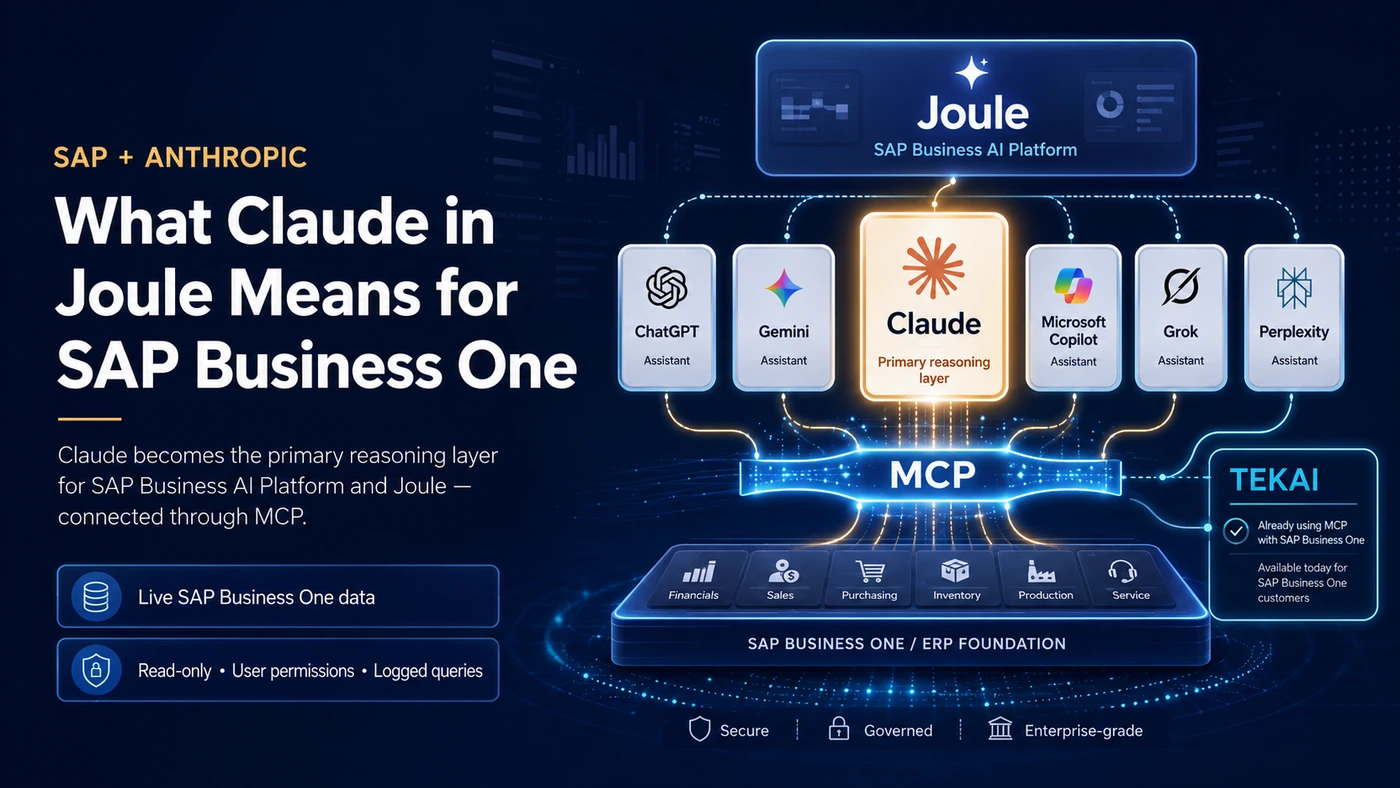
At SAP Sapphire in May 2026, SAP announced a partnership with Anthropic that makes Claude the primary reasoning and agentic capability of the new SAP Business AI Platform, and an extension of Joule. The connection between Claude and SAP’s systems runs over the Model Context Protocol — MCP.
If that acronym looks familiar, it should. It is the protocol TEKAI has used in production on SAP Business One since launch.
Three things, and it is worth separating them because they get merged in most coverage.
First, Claude becomes the primary reasoning model behind Joule and the SAP Business AI Platform. Not an option among several — the primary one, positioned across SAP’s portfolio.
Second, the connection is made over MCP. SAP did not build a proprietary bridge between its applications and Anthropic’s models. It adopted an open protocol designed for exactly this: letting a model reach a system it was not built against, under that system’s own controls.
Third, Joule Studio remains model-agnostic, with other model options named by SAP. Claude is primary, not exclusive.
Here is the part that matters, and where enthusiasm should be tempered.
This arrives for SAP Business One customers through the Business AI Platform and Joule agents as SAP rolls it out. It is not a copilot shipping inside the SAP Business One client today, and building on the platform involves SAP BTP subscriptions.
That is not a criticism of SAP. Platform capabilities roll out on platform timelines, and for the larger products in SAP’s portfolio the story is further along. But if you run SAP Business One and read the announcement as “Claude is now in my ERP”, the correction is worth having early: it is a direction of travel, not a feature you can switch on this quarter.
The distinction is between a capability SAP is rolling out and something running on your database now.
We have been making a specific architectural argument for a while, and it is now SAP’s argument too.
The argument is this: you do not put AI into an ERP by rebuilding the ERP. You put a protocol-level bridge between the database and the model, so that the model can ask questions under the permissions the ERP already enforces — and so that swapping the model later does not mean rebuilding anything.
That is what MCP is for. It is why TEKAI was built on it rather than on a bespoke integration with one vendor, and it is why TEKAI works across six assistants rather than one. SAP has now standardised on the same combination — MCP plus Claude on live ERP data — at the top of its portfolio.
TEKAI is featured in SAP’s own AI Partner Innovations playbook as one of four generative AI solutions for SAP Business One worldwide, and the only one from India. The playbook came first; the architectural agreement is the newer part.
We are not claiming credit for SAP’s decision. We are pointing out that a small company betting on an open protocol in 2025 and the largest enterprise software vendor in the world arriving at the same place in 2026 is a reasonable signal that the protocol was the right bet.
If you run SAP Business One and want AI on your live data now rather than on a platform roadmap, that already exists.
TEKAI connects your SAP Business One database to Claude, ChatGPT, Gemini, Microsoft Copilot, Grok and Perplexity over MCP. Access is read-only by default, provisioned per user against your existing SAP Business One authorisations, and every question is logged. Answers are grounded in your data, and your data is not used to train the model.
It is ₹5,000 per company per month in India, or $150 per company per month globally, and you bring your own AI subscription — so the AI relationship stays between you and the model vendor.
The route most customers take first is Claude on SAP Business One, which is the same model SAP has now built Joule on. The mechanics for all six assistants are in the guide to connect AI to SAP Business One, and the product itself is on the TEKAI page.
Three things worth tracking over the next few quarters.
Whether the Business AI Platform reaches SAP Business One customers on a timeline that is useful to a mid-sized business, and what it costs when it does. Platform pricing is where roadmap enthusiasm usually meets the budget.
Whether Joule agents for SAP Business One arrive with the depth that the larger products get, or in a reduced form. SAP Business One has historically received a version of what the enterprise products get, later.
And whether the model-agnostic position holds. It is the right architecture and SAP has stated it clearly — but a primary model has a way of becoming the only model that anyone bothers to test against.
For the wider picture of what AI can and cannot do on an ERP today, including where Joule fits, see the guide to AI in SAP Business One.